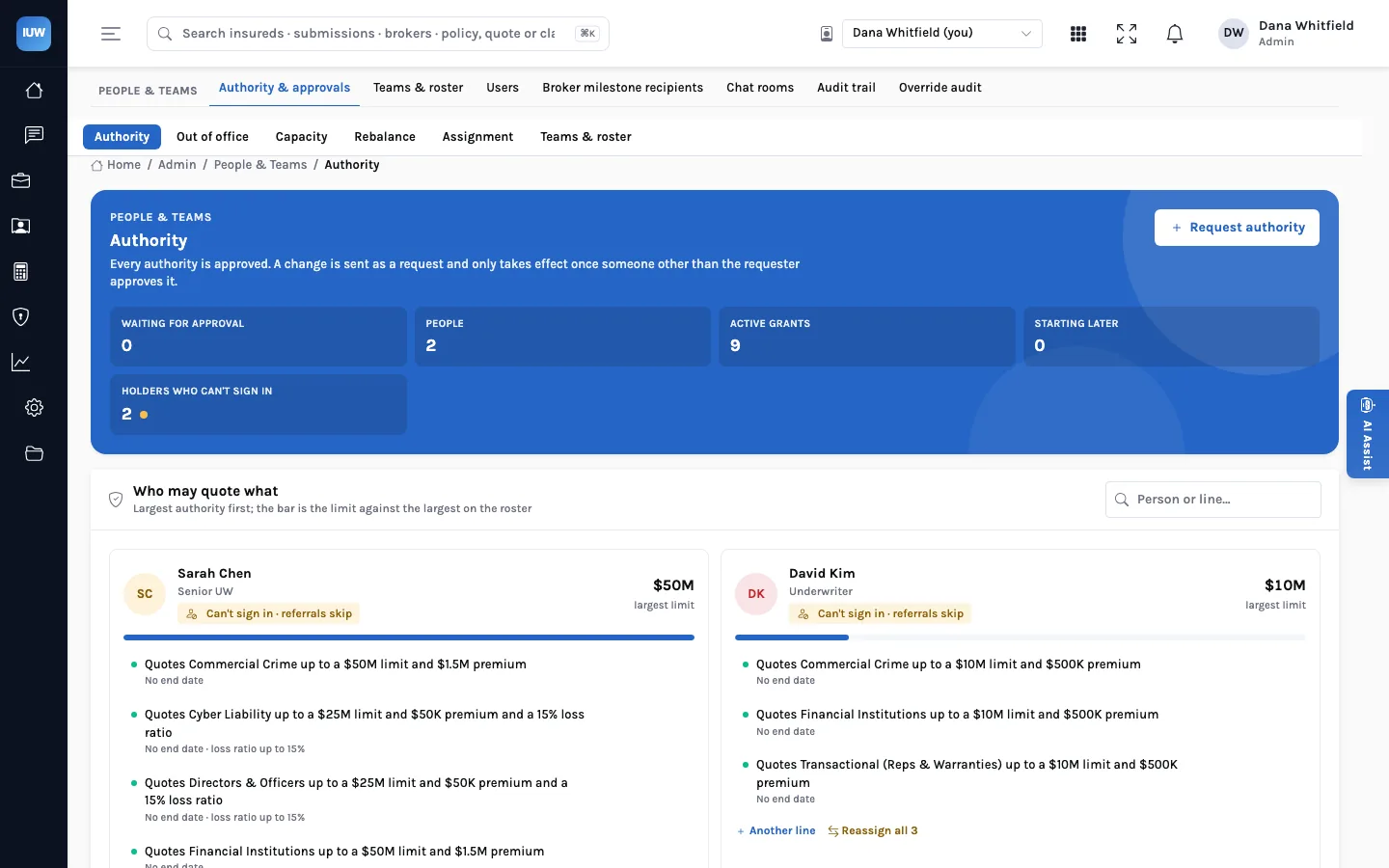
This is a worked example with made-up people and companies: a financial institutions underwriter at a fictional specialty carrier, and one new bankers professional submission for a fictional community bank. It shows what the agents have done before she opens the file, and what she still decides.
In short
- The file arrives prepared: Analyze has run clearance, appetite, enrichment, the risk brief and a price.
- The decision record recommends proceed with seven checks passed, and says why a person is still needed.
- The price shows its working: a base premium, each rating factor's effect, and a confidence based on which features were available.
- The underwriter decides what the agents can't: whether the missing information matters, and the terms.
The situation
Sarah Chen and Harbor Trust Bancorp
Sarah Chen is a senior underwriter (fictional) for financial institutions. A broker has sent a new bankers professional submission for Harbor Trust Bancorp (fictional): a $10M limit, effective in January. The submission arrived three days ago and Analyze ran on it overnight.
1. What needs me
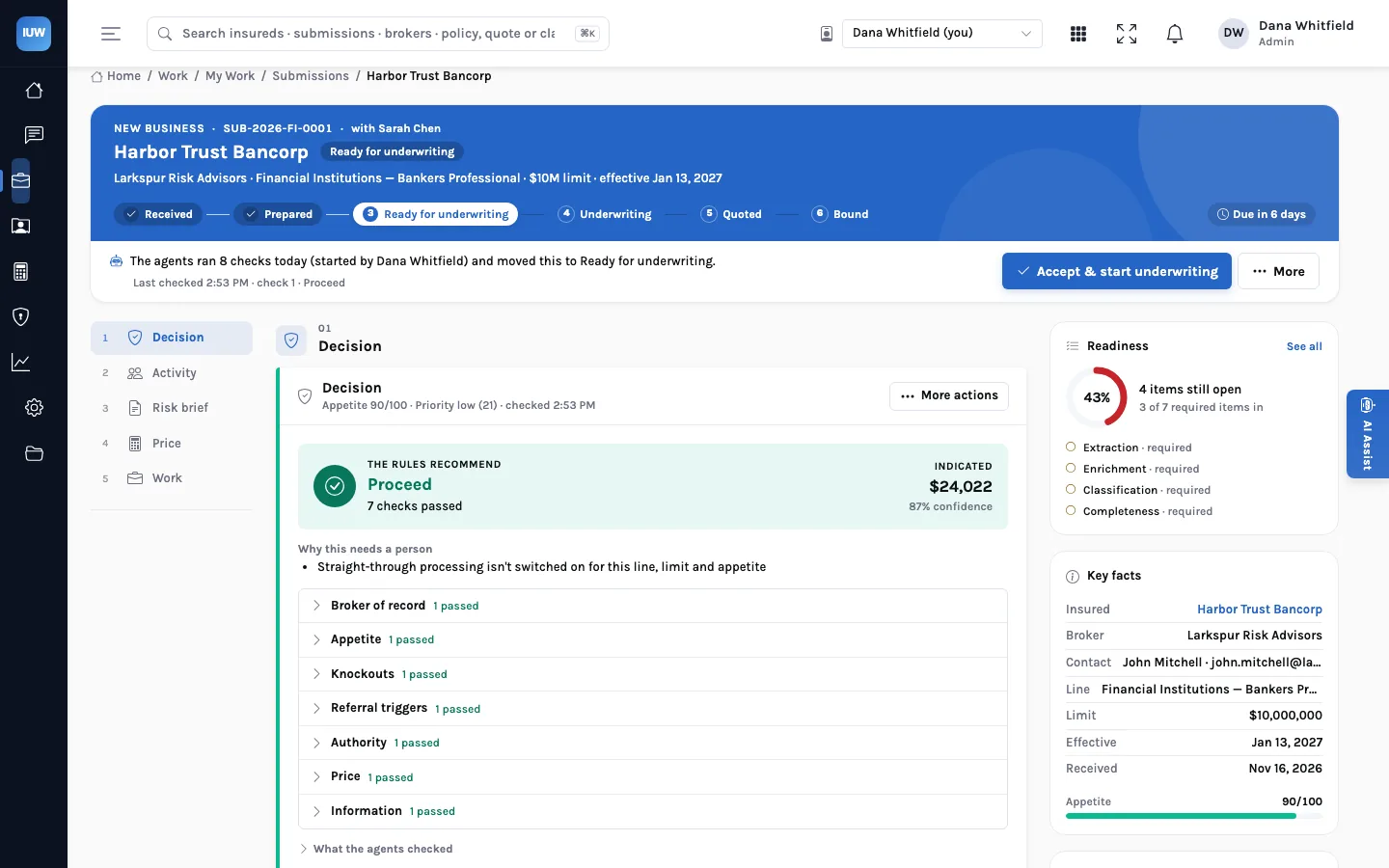
Sarah's Home page lists what is waiting on her. The submission isn't there as a task to prepare: it is at Ready for underwriting, with the agents' summary in its banner: The agents ran 8 checks today and moved this to Ready for underwriting.
2. The decision record
The Decision zone says the rules recommend Proceed, seven checks passed, an indicated premium of $24,022 at 87% confidence. Under Why this needs a person there is one line: straight-through processing isn't switched on for this line, limit and appetite. So the recommendation is a starting point, not an action.
3. The risk brief
She reads the brief. The institution profile lists the bank's type, total assets, tier 1 capital ratio, regulatory actions, securities class actions and restatements, with a scorecard weighting each. One item is flagged: assets under management is not on file, and the model treats it as neutral until it is.
4. The price
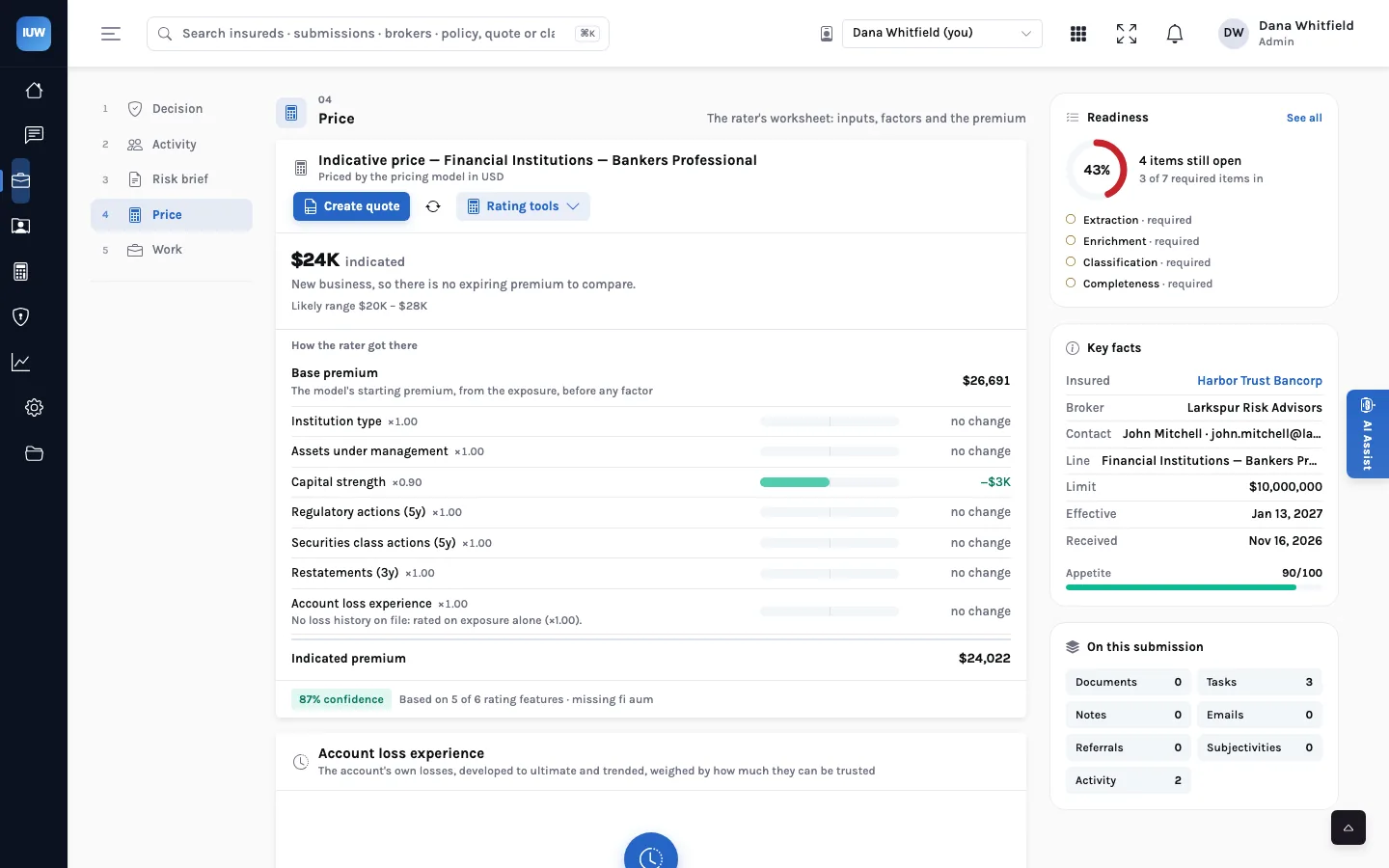
The Price zone is the rater's worksheet. It starts from a base premium derived from the exposure, then applies each rating factor, showing its multiplier and its effect in dollars. Here only capital strength moves the price, down by about ten percent. The indicated premium, a likely range and the confidence are at the bottom, with the note that it is based on five of six rating features because assets under management is missing.
5. What Sarah decides
- 1Is the missing item material?underwriter
Assets under management is neutral in the model. For a bank with a trust department she wants it, so she asks the broker for it rather than quoting blind.
- 2Termsunderwriter
She settles the retention and any subjectivities she wants before binding.
- 3Start underwritingunderwriter
Accept & start underwriting moves the submission to the Underwriting stage, owned by her.
- 4Create the quoteunderwriter
From the Price zone, Create quote builds the quote from the latest price, with the line's standard forms and recommended subjectivities; options can be added.
Before sending, the send checkpoint applies: a first quote to a broker or insured, manuscript wording or a non-USD quote stops for a person. A broker email can be drafted for her to edit and send.
6. If Sarah disagrees with the price
Suppose Sarah thinks the indication is light for a bank with a trust department and wants a higher premium. She changes the figure rather than working around it. The change is recorded as an override on the priced quote, with a reason code and her justification, and it is checked against her authority: within it, the override applies; beyond it, it waits for approval. Either way the original indication stays visible, so a reviewer can see what the model said and what the underwriter decided.
What would have changed the picture
The file reached Ready for underwriting because no checkpoint fired. With the default settings, any one of these would have parked it for her instead:
| If… | Checkpoint | What Sarah would see |
|---|---|---|
| the indication were more than 15% away from the expiring premium | price | The change against expiring, and the question: accept the price or change it |
| price confidence were below 60 | price | Which rating features were missing |
| the $10M limit were above her grant for the line | authority | A prepared referral to her manager |
| a required loss run were missing | information | A recommendation to chase the broker for the missing item |
| the broker had never sent the carrier a submission before | appetite judgement | A first-submission flag on the broker |
Reading the confidence and the range
Two numbers sit beside the indicated premium and mean different things. The confidence measures how much of what the rater wants is on file for the insured: a published pricing model's confidence runs from 50 with nothing to 95 with everything, a desk-rate table's from 40 to 80. The range is a fixed spread either side of the indication, there to remind the reader it is an indication. Neither is a probability that the price is right. Where at least three priced quotes exist on the same line, the Price zone also shows where the indicated rate per $1,000 of limit sits among them; with fewer, it says there aren't enough to compare.
Sarah's checklist for a prepared file
- Read Why this needs a person first. It tells you what the agents could not settle.
- Open each check group that didn't simply pass, and read the reason.
- Look at the brief's missing list and decide, item by item, whether it matters for this risk.
- Check which rating factors moved the price, and whether any were neutral only because data was missing.
- Glance at similar past decisions before setting terms.
What the agents did not do
They didn't decide that the missing figure was immaterial, choose the retention, or send anything. They assembled the file, ran the checks and built a price that shows its working, so Sarah's time went on the questions only an underwriter can answer.
Made-up figures
The premium, factors and bank in this example come from InsightUW's demo seed data. They illustrate how the worksheet is laid out, not how any real risk should be priced.
Questions buyers ask
Does the pricing model replace our rater?
It uses yours. The indication comes from a pricing model or desk-rate table the carrier publishes for the line, or from a completed pricing quote already on the submission. InsightUW lays out the working; it doesn't supply rates of its own.
What if the line has no rater yet?
The Price zone says no rater is configured and the premium stays empty. Sarah prices by hand, and the decision record says so.
Can a quote go out without Sarah?
Not with the defaults. Straight-through quoting is off for every line until a carrier switches it on, and even then the ceiling on agent autonomy (L2 by default) keeps a person in the loop.
Screens show a local InsightUW workspace with made-up insureds, brokers and underwriters. Nothing here is a statement about any real company's risk.