An agent that never stops is a liability, and one that stops for everything is no help. InsightUW draws the line with checkpoints: a short list of moments where the pipeline must hand the submission to a person. When it stops, it doesn't just raise a flag. It leaves a prepared decision.
In short
- Seven checkpoints: information, appetite judgement, price, authority, send, bind and decline.
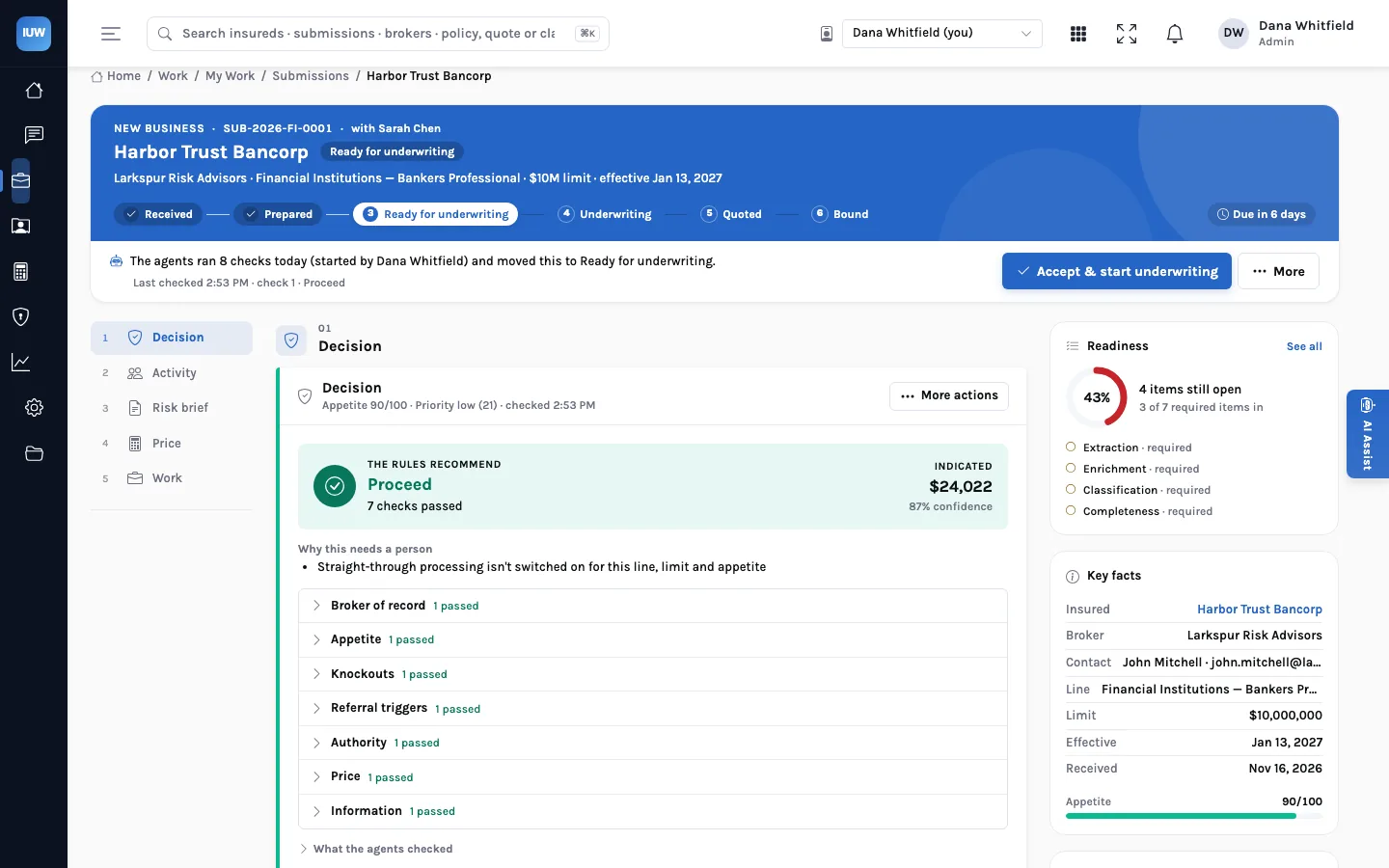
- Decline always stops for a person, and bind does by default; the others fire when their conditions are met.
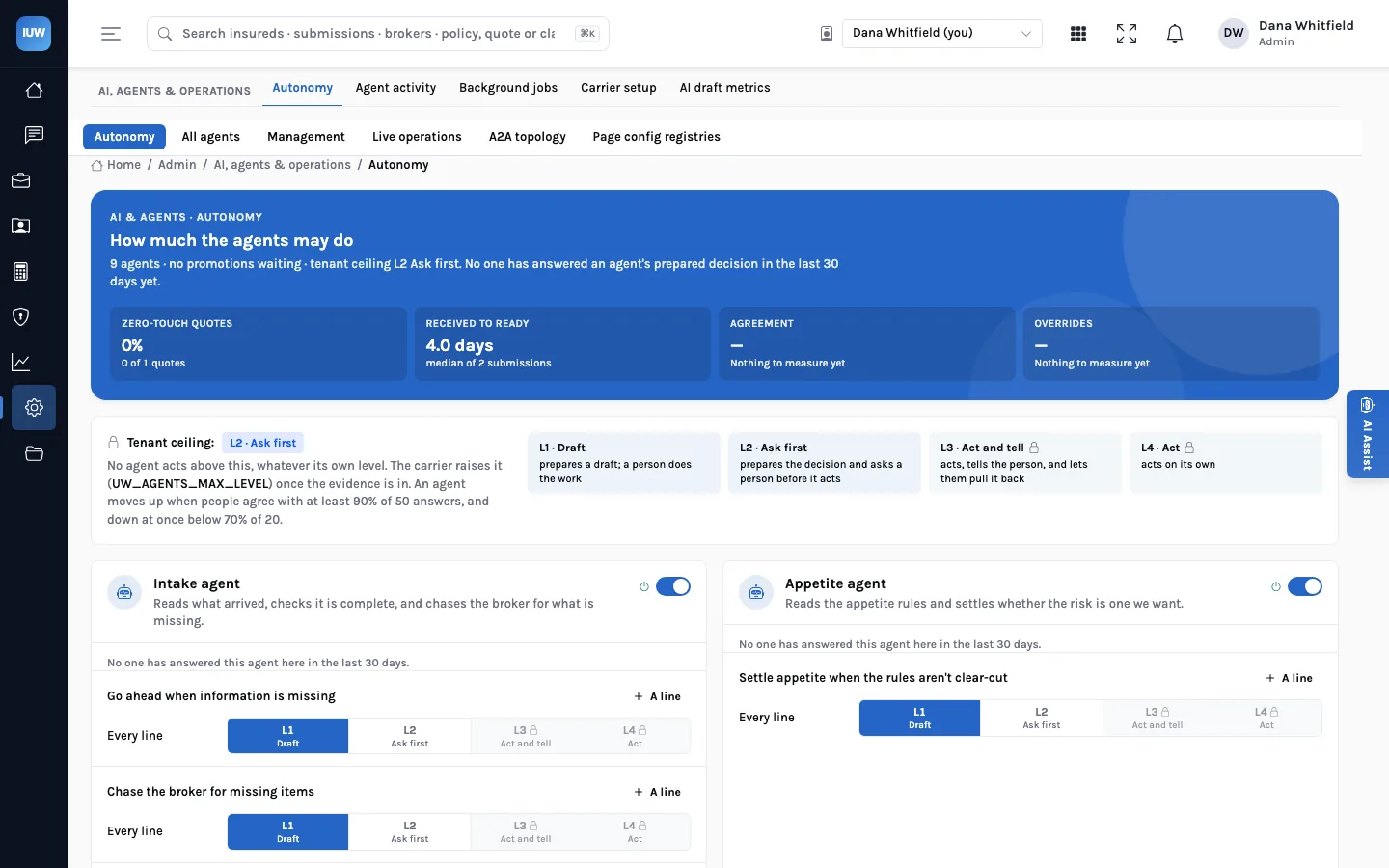
- Each checkpoint is a row a manager controls: scope by line, thresholds, on or off, and its autonomy level.
- A prepared decision says what the agents recommend, why, what they already did and the one question; a person accepts, changes, rejects, asks or skips.
The seven checkpoints
Four checkpoints are evaluated when Analyze reaches its gate: information, appetite judgement, price and authority. Two are evaluated at their own moment: send when a quote is about to go out, and bind at binding. Decline applies whenever a decline is proposed. Alongside them sits one policy, straight-through auto-quote, which is off by default and switched on per line.
The checkpoints are stored as rules, so a manager can scope one to a line, switch it off, change its threshold or raise its autonomy level without an engineer. Rules Studio manages them with the other rule types.
What a parked submission looks like
Here a made-up fiduciary liability submission has been analysed. The checks passed except the referral trigger: the assigned underwriter has no authority set up for fiduciary. The header says Waiting on Underwriting Manager: authority approval, and the Decision zone shows the recommendation, Refer to a manager, with the prepared decision underneath.
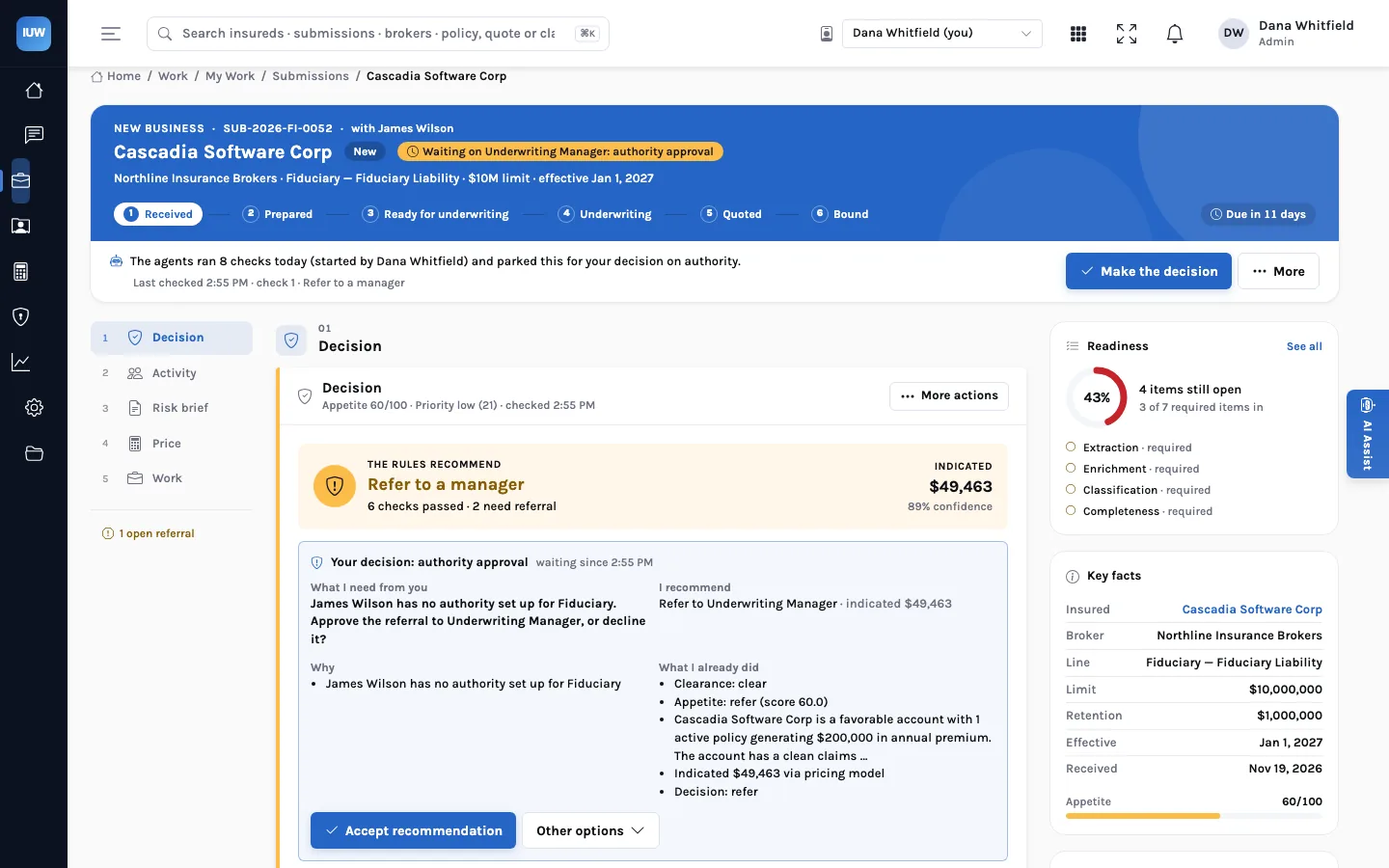
The prepared decision has four parts:
- What I need from you: the one question, here to approve the referral to the underwriting manager or decline it.
- Why: the rule that fired.
- I recommend: the action and the indicated premium.
- What I already did: the outcome of clearance, appetite (with its score), the account summary, the price and the decision.
Accept recommendation takes the recommended action. Other options lets the person change it, reject it, ask a question back, or skip a step. Whichever they choose is recorded as feedback on the agent's recommendation, which is what autonomy levels are later tuned on.
Tuning a checkpoint
A checkpoint that fires on almost every submission teaches people to click through it; one that never fires may be scoped too narrowly. Watch how often each fires per line and how often people change the agents' recommendation when it does. A price checkpoint with a tolerance that is too tight, for example, shows up as a stream of accepted recommendations nobody needed to see.
Where parked work shows up
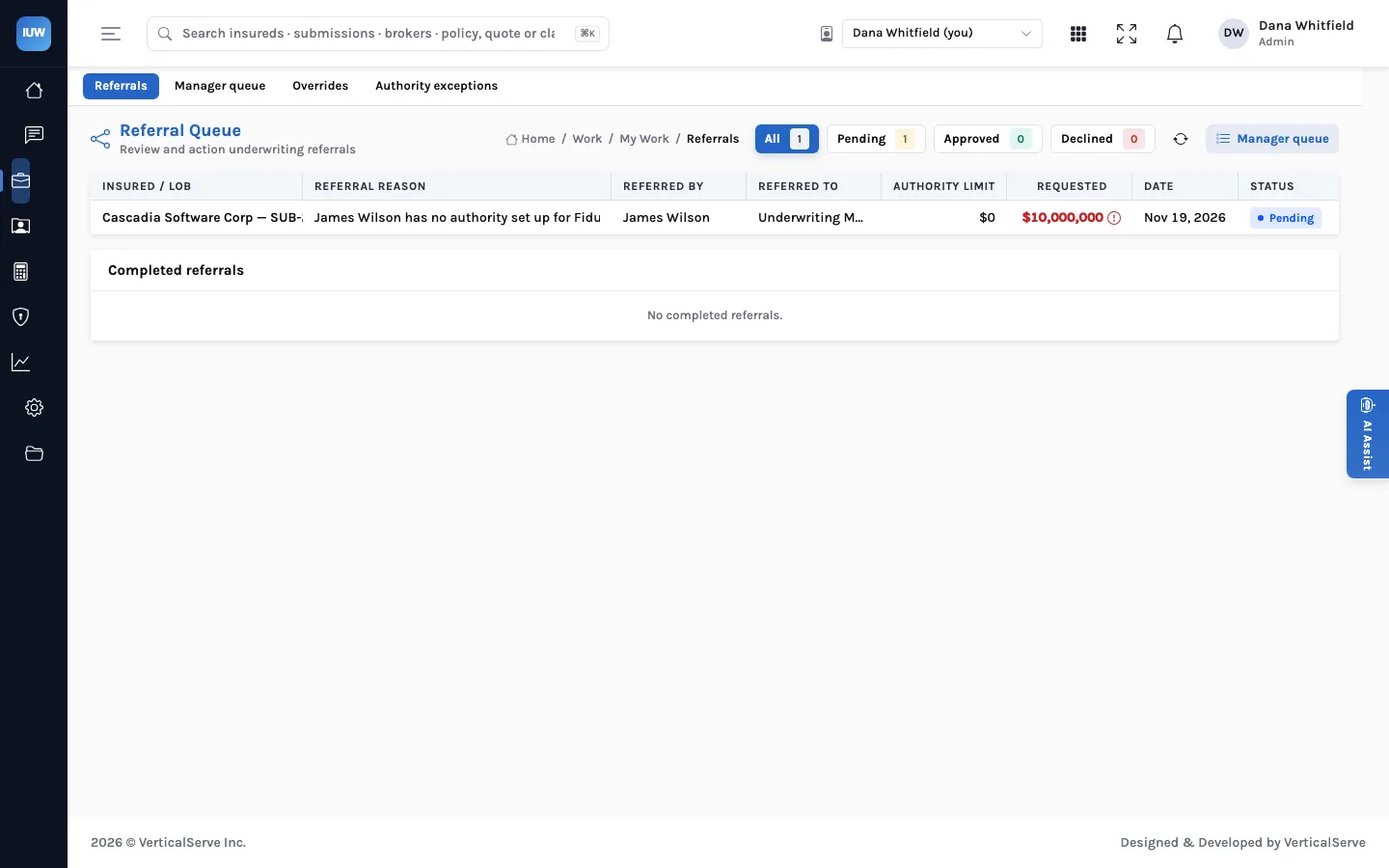
A parked decision appears in the right person's What needs me on Home. Authority referrals also appear in the Referral Queue, with the insured and line, the reason, who referred it, to whom, the authority limit, the requested limit, the date and the status.
Answering a referral before lunch
Tom manages the management liability team at the fictional Harborline Specialty. A fiduciary submission for a software company is parked for him because the underwriter it was routed to has no fiduciary authority. The prepared decision shows clearance clear, appetite refer at 60, and an indicated premium.
Tom doesn't approve the referral as it stands; he changes it, reassigning the submission to a colleague who holds fiduciary authority. The change is recorded against the referral agent's recommendation.
Why bind and decline stop by default
Binding commits the carrier, and a decline affects a broker relationship and, in some lines, regulatory obligations. InsightUW has a person confirm every decline, and every bind unless the carrier changes that checkpoint, whatever autonomy level the agents have elsewhere. Agents can prepare the binder or draft the decline letter; a person sends it.
The defaults, condition by condition
Each checkpoint ships with conditions a manager can change. These are the starting values:
| Checkpoint | Fires when (default) |
|---|---|
| information | a required item is missing; extraction confidence is below 80%; or extracted fields are flagged for review |
| appetite judgement | appetite says refer; the appetite rules disagree (some accept, some refer or decline); or it is the first submission from a broker nobody has seen |
| price | the indication is more than 15% either side of expiring; price confidence is below 60; the rate adequacy ratio is below 0.85; or a line's scorecard puts the risk in its refer tier |
| authority | a referral rule fires, or the limit, premium or loss ratio is beyond the assignee's grant |
| send | the first quote to this broker or to this insured; manuscript wording; a quote not in US dollars |
| bind | always |
| decline | always |
Two further checkpoints sit outside the seven because they belong to other flows: renewal terms, where the renewal pipeline parks a renewal for a person at 90 days to expiry, and binding authority, which stops a bind on a delegated-authority program's submission that falls outside the program's grant.
When several fire at once
A difficult submission can trip more than one checkpoint. The person is asked about the most serious first, in this order: decline, authority, appetite judgement, information, price. The others are listed on the prepared decision as also fired, so nothing is hidden, but the question at the top is the one that has to be settled first. A manager approving a referral doesn't need to answer a price question that the underwriter will deal with anyway.
What each answer actually does
| Answer | Effect |
|---|---|
| Accept | Takes the recommended action: proceed to ready for underwriting, refer, chase the broker, or decline |
| Change | Alters one thing first, then proceeds. Changing the premium creates an authority-checked override on the priced quote, which may itself need approval; changing the assignee reassigns the submission |
| Reject | Keeps the submission with the underwriter for manual handling, with the reason recorded |
| Ask | Records the question and leaves the submission waiting; the assistant panel opens. Nothing counts as agreement or disagreement |
| Skip a step | Records that a person chose to skip a pipeline step. A reason is required |
Every answer is a sign-off on the decision record, with who gave it and when. Accept, change and reject count towards the agent's agreement rate; ask does not.
Re-runs don't ask twice
Analyze runs again when a new document arrives. If a manager has already approved an authority referral and the risk still sits within that manager's own grant, the re-run doesn't park the submission on the same question. If the limit or premium has grown past it, the checkpoint fires again, because the earlier answer no longer covers the risk.
How to decide your thresholds
- Start from the defaults on one line and watch for a month before changing anything.
- Scope changes to a line. A line-specific row wins over the default, so a tight price tolerance on one volatile line doesn't affect the others.
- Use a dry run on a few real submissions to see which checkpoints a new threshold would fire before publishing it.
Questions buyers ask
Can we add our own checkpoint?
The checkpoint codes are fixed; their conditions, scope, level and wording are yours. Most carrier-specific stops are better written as referral or appetite rules, which then feed the authority or appetite checkpoint.
Does switching a checkpoint off remove the check?
No. The check still runs and its result stays in the decision record; switching the checkpoint off only stops it parking the submission. Decline and bind are the two to leave on.
Screens show a local InsightUW workspace with made-up insureds, brokers and underwriters. Nothing here is a statement about any real company's risk.